Welcome to our ongoing journey into the practical applications of Artificial Intelligence (AI). Today, we’re going to explore how AI can assist us in planning a Father’s Day feast for our family.
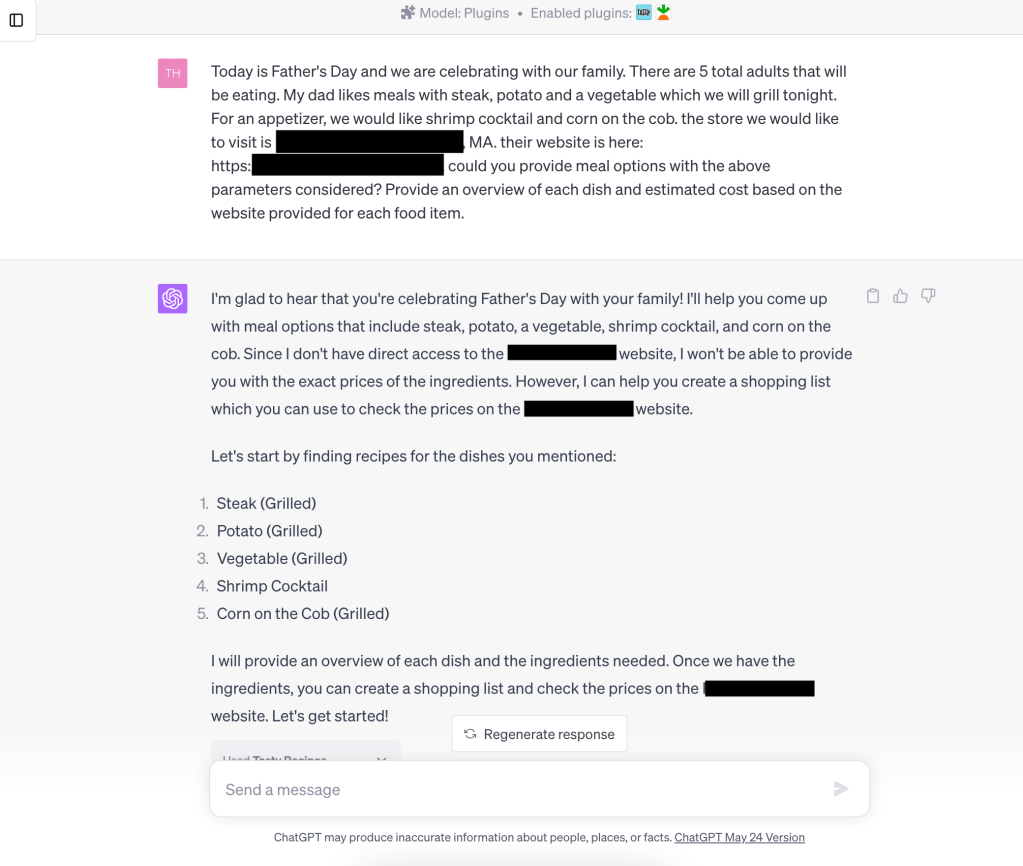
Our challenge back in June was to create a meal plan for a Father’s Day celebration, taking into account specific food preferences and dietary needs. We were tasked with preparing a meal for five adults, with a menu that included grilled steak, potatoes, vegetables, shrimp cocktail, and corn on the cob (per my dad’s request of course). The shopping was to be done at a local grocery store and we needed to budget price before leaving the house.
To tackle this challenge, we turned to AI, specifically a language model developed by OpenAI called GPT-4. This AI model is capable of understanding and generating human-like text based on the input it receives.
GPT-4, which stands for “Generative Pretrained Transformer 4,” is like a really smart digital assistant that’s been created by a group called OpenAI. It’s really good at working with language and can help with all sorts of tasks that involve words and sentences.
Think of GPT-4 like a super-powered version of autocorrect on your phone. When you start to type something, your phone tries to guess what word you want to use next. GPT-4 does something similar, but instead of just predicting the next word you’re going to type, it can write whole sentences, paragraphs, or even an entire article. It can also answer questions, help you learn new things, and even write a little bit of code.
The way GPT-4 works is a bit like a parrot that’s learned to mimic human speech. It’s been trained on lots and lots of text – books, articles, websites, and so on – and it uses patterns it has picked up from all this training to generate its own sentences. But it’s important to remember that, just like a parrot, GPT-4 doesn’t really understand what it’s saying. It’s just really good at copying the way humans use language. This is perfectly fine for our use case in this blog series but might not cut it when being leveraged to assign medicine to a patient in a life or death scenario (for now), for example.
So, while GPT-4 is a complex piece of technology, at its core, it’s really a tool that helps us with language. It’s becoming more and more common and is starting to be used in many different areas of life, from customer service to education to entertainment. And as we explore AI in this blog series, you’ll see just how much it can do.
The first step was to use the AI to find recipes that matched our meal requirements. We asked the AI to search for recipes for grilled steak, grilled potatoes, grilled vegetables, shrimp cocktail, and grilled corn on the cob. The AI was able to suggest common recipes for each of these dishes, providing an overview and a list of ingredients for each one.
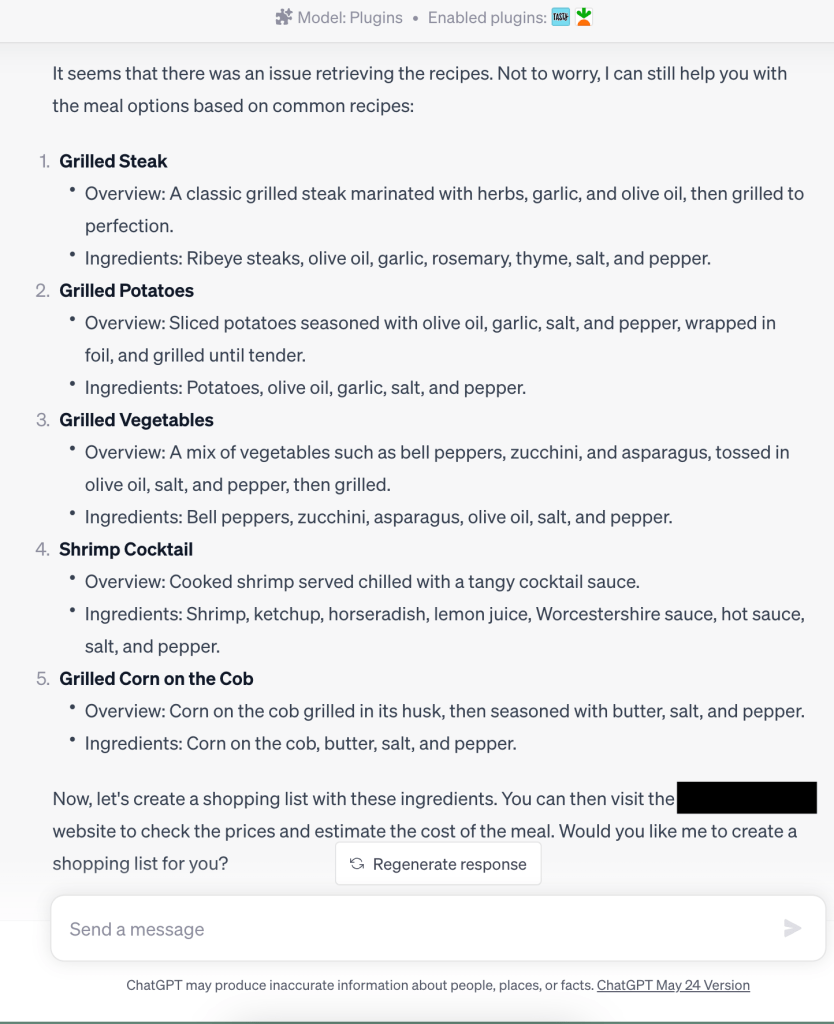
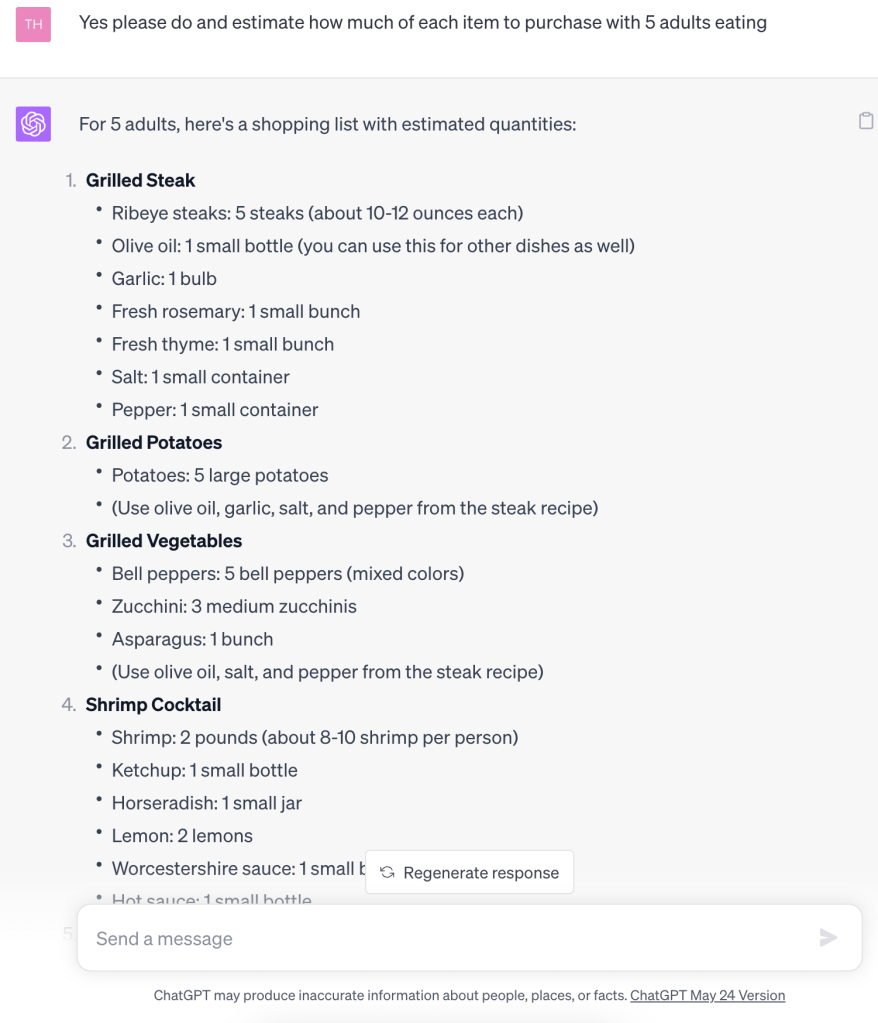
Next, we asked the AI to create a shopping list based on these recipes, taking into account the number of people we were serving. The AI provided a detailed list, estimating the quantities of each ingredient we would need.
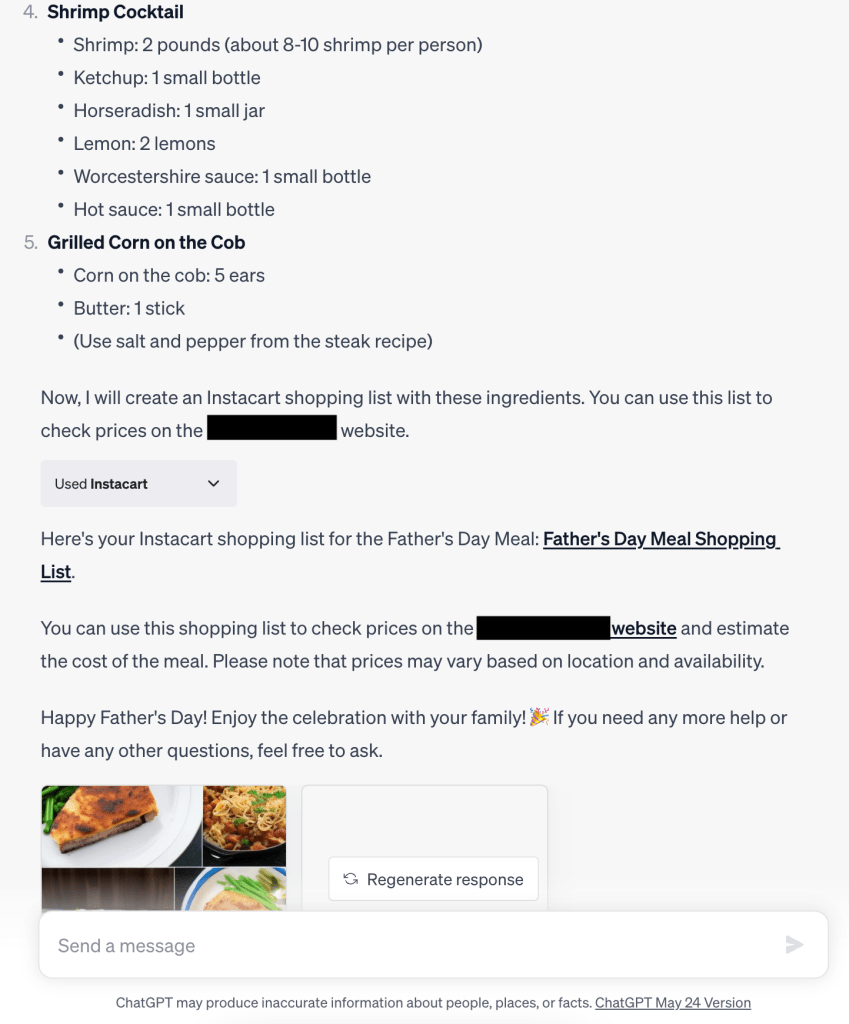
Finally, we used a special tool, kind of like a helpful add-on, called a plugin, with the online grocery shopping service, Instacart. For those who might not know, Instacart is like your personal grocery shopper. You can choose what you want from your favorite store online, and a dedicated shopper will pick and deliver them to your doorstep.
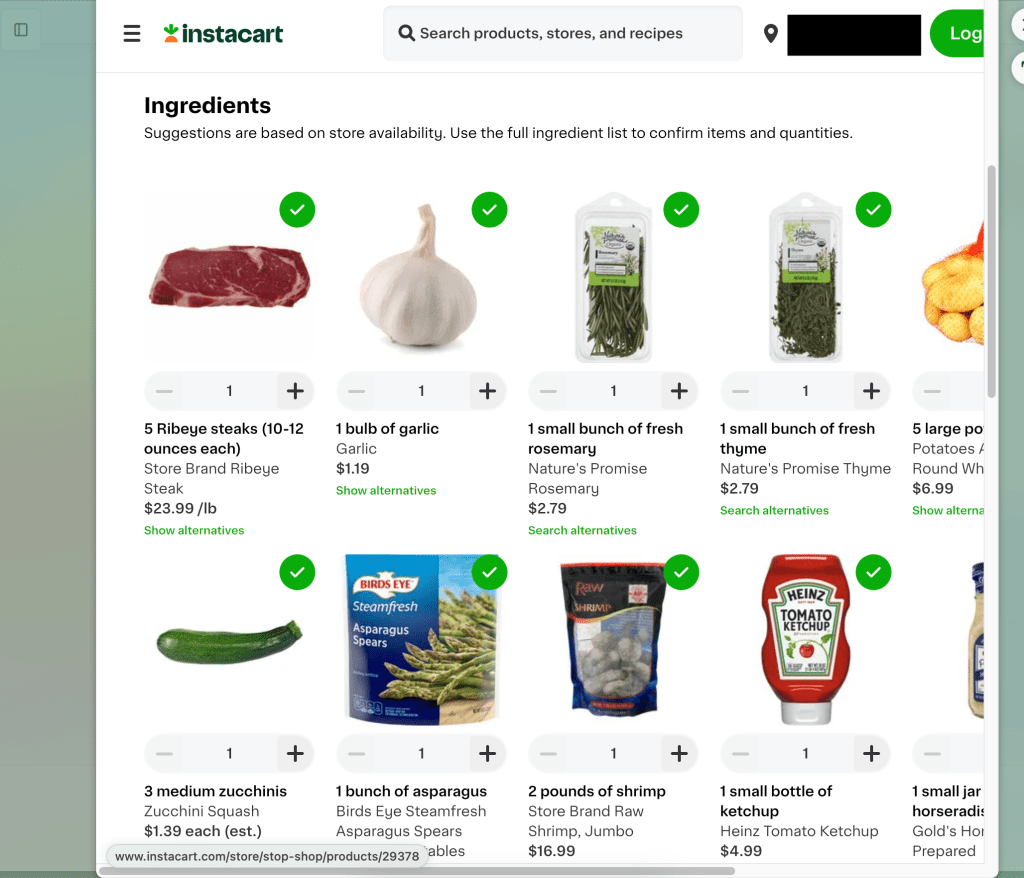
So back to our plugin – this tool helped us create a shopping list based on the ingredients we needed. It’s like giving Instacart a superpower where it can check the prices and whether these ingredients are available at our local Roche Brothers store. Think of this process similar to adding an app on your iPhone, rather than going to the website directly through a web browser. Once the list was ready, the AI came up with a link to our Instacart shopping list, which we could use to get an idea of how much the meal might cost. It’s a really convenient way to plan your meals and manage your grocery shopping!
Throughout this process, the AI was a valuable assistant, helping to plan the meal, find recipes, and create a shopping list. This experience showed us that AI is not just about complex algorithms and high-tech applications. It’s about practical, everyday uses that can make our lives easier and more enjoyable. Whether it’s helping to plan a Father’s Day feast, organizing a shopping list, or finding the perfect recipe, AI is there to assist us in our daily lives.

Now could we have created this meal ourselves from memory? Of course we could have – you didn’t expect me to wow you with our first post now, did you? This is simply the appetizer and a nice early intro into our series. As we continue our journey into the practical applications of AI, we’re reminded that it’s not just about understanding the technology, but about exploring how it can be used to enhance our lives in meaningful ways. So, let’s continue this exciting adventure together. Let’s all make our lives 1% easier tomorrow.

 mike murphy