Mathematical properties run the world. Seemingly random phenomena can be explained by probability theory.
Playing Card Permutations
Playing cards have been around since the 9th century in China. Eventually, trade routes spread cards and games through the Middle East and into Africa and Europe. By the 18th century, a standard deck with 52 cards sorted into four suits began to emerge as the incumbent. As long as games with monetary prizes exist, humans will look to gain an edge over the competition. Trying to predict the next card that is flipped has forever been a goal of players, going all the way back to 9th century China. To counteract the predictability of card order, dealers shuffle the deck multiple times.
Each standard deck of cards has 52 individual cards and 4 suits. Although every poker player sitting down on the felt wishes he could predict the next card being flipped in front of him, it’s a near impossible task. Casino operators worked closely with mathematicians in the late 1900s to determine how to maximize the randomness of card order for the games they offer patrons. After 7 shuffles, it has been determined that the order of a deck of 52 cards is more likely than not to have never existed in the history of the world. These are very large numbers we are dealing with. On the surface, it seems like that is an impossible statistic. Let’s take a look at the math:
A standard deck of playing cards has 52 unique cards. The total number of possible ways to arrange these cards, known as permutations, is extraordinarily high. This number is calculated as ‘52 factorial’ (noted as 52!), which is 52 x 51 x 50 x 49 …. x 2 x 1. The resulting number of permutations is larger than the total number of atoms that exist on earth. Your standard iPhone calculator can’t handle this sort of calculation, so we will take a glance at WolframAlpha to see the exact total:
52! = 52 x 51 x 50 x 49 … x 2 x 1 =
80658175170943878571660636856403766975289505440883277824000000000000
That number of possible permutations is impossible to comprehend in the human brain. It has 68 digits and is also known as 80 unvigintillion. Every shuffle of the deck can be seen as a minor change in the initial order of cards, but leads to an additional permutation. Given the history of playing cards spanning several centuries, it’s an interesting thought experiment to think about how many games and hands have been dealt.
Life in the Middle Ages
From a historical perspective, life seemed to go sideways in the middle ages. From the 5th to the 15th century, much of our written history involves one kingdom going to war with another kingdom to slightly move battle lines a few football fields one way or another, avoiding plagues, and learning how to farm effectively.
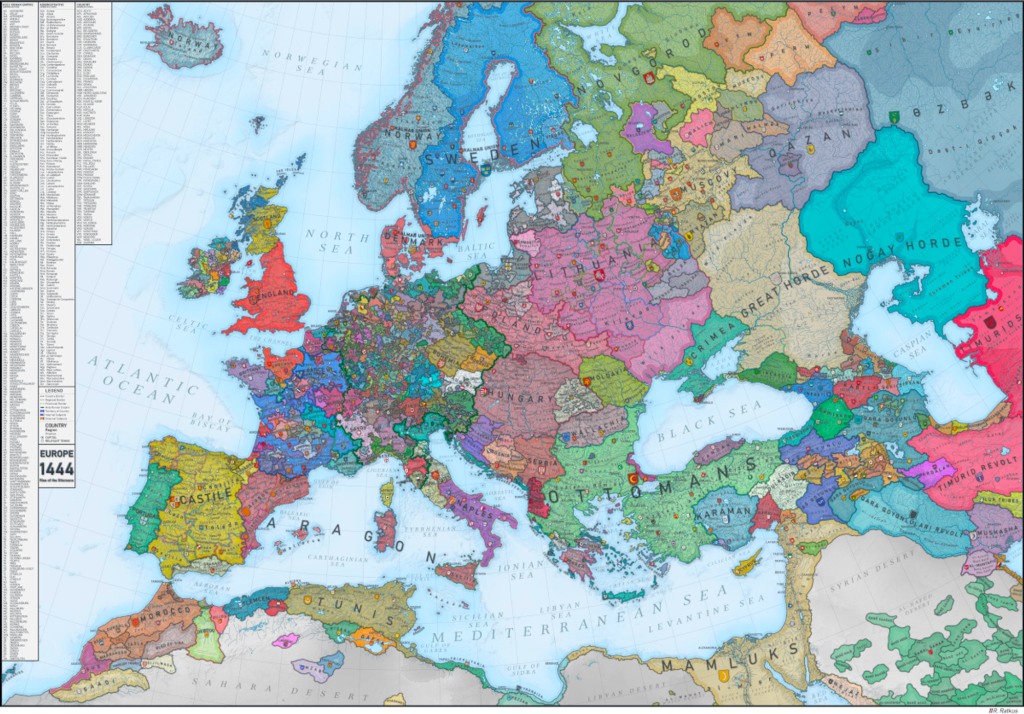
Life as a serf in medieval Europe wouldn’t be much of a destination even if you had a time machine with unlimited use sitting on your desk. Serfs were peasants who worked in the fields and lands owned by a lord. They weren’t slaves necessarily, but they could not lawfully leave the estate without permission directly from the lord. The day to day involved hard manual labor, a strong dependency on the local lord of your kingdom, and days off spent sitting in church listening to Latin which you did not understand. You were illiterate and likely malnourished. You did not travel outside your village during your entire short lifespan, unless it was to go to war. Schooling was not an option and your interactions were solely with with individuals who lived lives exactly like your own and lived directly beside you. The main working hours were spent planting and harvesting crops, tending to livestock, and performing other necessary tasks to keep the estate up and running. Your living conditions were small, simple cottages made of wood and daub packed with large families. The lives of millions of people in Europe involved being born into a family of serfs, working on the farm owned by a lord, interacting with humans that had the exact same life experiences that you had, and dying on that same plot of land. It’s not a shock to see that the world didn’t experience massive technological breakthroughs during this period. Diversity of thought and ideas was not a widely shared experience when compared to other golden ages of history – like the one we are currently living in.
Modern Day Inputs
Modern day individuals absorb more information, experiences, and diversity of thought in one day than a serf would consume in an entire lifetime. Firing up Twitter for a morning scroll with coffee exposes us to geopolitical events happening a 12 hour plane ride away. Reading the front page of the Wall Street Journal covers market activities of companies that make the sneakers we order on the internet for home delivery. Online work allows us to fire up a computer from our homes and join virtual meetings with colleagues located in New York, Boston, London, Paris, and Berlin all at the same time. Instead of physically planting crops, our jobs can focus on delivering intangible value to society, such as an investor providing capital to businesses looking to expand. Once the workday is over, you might throw on a podcast and go for a run – tracking with Strava for your friends located around the country to view, of course. After dinner you’ll pick up the latest Walter Isaacson biography of a human you have never personally met, but are able to study their decision making throughout the most crucial moments of their professional and personal lives. To wrap up the night, you’ll buy access to HBO to watch a classic Scorcese movie you haven’t yet seen from the 90s.
It’s clear to see that our lives from 2023 have more inputs of knowledge on a daily basis than ever before in human history. Instead of being limited to the thoughts, experiences, knowledge and lifestyles of the small communities surrounding wherever we were lucky / unlucky enough to be born, the modern human can access these inputs from around the world and across human history. Think of each of each of these inputs as a playing card that is shuffled together to produce a unique output. Each permutation of the deck results in unique thoughts and actions made by humans. In the dark ages, the decks of most humans on Earth might be made up of 10-12 cards and a majority of the outputs of thought and creativity were similar, if not outright the exact same. The result was a lack of innovation and creativity where much of technology went sideways for hundreds of years and generation after generation. In 2023, the number of cards available to us is limited in only our curiosity of how life works on this planet. The more cards we each collect, the more unique our outputs, and the better off society as a whole will function. It is our duty to gather as many inputs as we can and continue to stack the deck in our favor.

 mike murphy