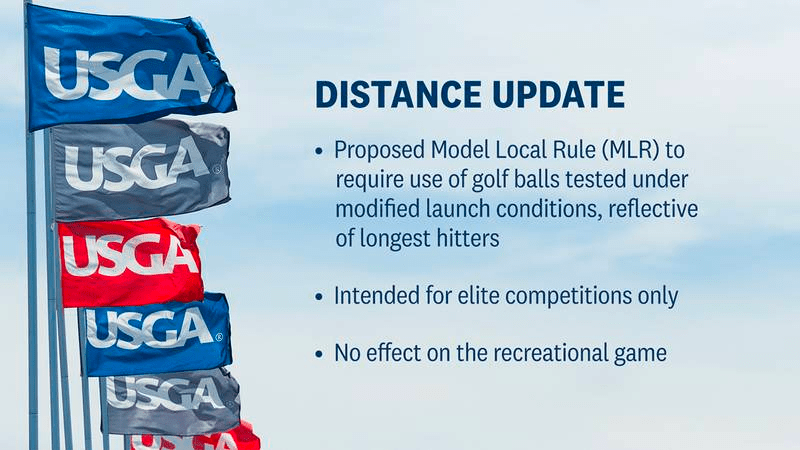
The USGA and R&A, golf’s two main governing bodies, proposed a new rule that provides elite professional and amateur tournaments the option to require distance constraints on the golf ball. These new rules won’t take place unless adopted by the organizers of said tournaments and until January 2026 at the earliest. Essentially, the top end hitters would lose about 15 yards on their average drives with a proportional loss rippling throughout the rest of the field.
A major focus point from this proposal is who it’s coming from. The USGA runs the US Open alongside numerous high end amateur events and this is reflected across the Atlantic by the R&A. What neither of these governing bodies decide upon are the local rules in place at The Masters, PGA Championship, or PGA Tour. Regardless if you’re a fan of Ronald Regan or not, there is a true trickle down effect in golf. Whatever the top 0.01% of competitors are doing, your local duffers are attempting to replicate the same. At least, this has been what the historical argument has been against making separate rules for the pros and ams. So why are we even considering limiting distance?
The USGA could use an improvement on defining what the problem is. Golf is a unique sport in many facets, with a major driver (see what I did there) being the uniqueness of the playing fields week after week. Despite each week on tour consisting of 18 individual holes, 4 rounds of competition, roughly 6,900 – 7,800 yards of distance, and the singular goal of the lowest posted score on Sunday afternoons – the week to week map on how to reach hoisting a trophy looks drastically different. Even someone who has never watched golf in their life would agree that there is a clear difference between Augusta National, The Country Club (Brookline), and St. Andrews. These are the historic venues that have hosted the most important major championships in golf lore, and ideally for years to come. But here is where we arrive at an issue, so many of these great courses are already playing to the absolute limit of distance.
At the 2022 US Open at TCC, holes that were used during the the famed US comeback during the 1999 Ryder Cup were axed for those that would lengthen the course. Also, TCC had to rent land from a neighboring property for a further back tee box on the 5th hole for an undisclosed amount. This is all for a tournament that takes place on property once every 30+ years. Famously, Augusta National has had (now annual) changes on property since a certain individual with the initials TW earned his first green jacket in ‘97. After Woods’ 12 shot victory, Augusta decided to grow rough (aka the ‘second cut’) in for the first time in history. Pushing tee boxes back 5 yards here and 10 yards there have since become annual traditions. In 2016, a neighboring property was purchased outright by the club to try and keep pace with the rapid improvement in club & ball advances resulting in distance gains that altered the spirit of how designer Alister MacKenzie intended the layout to be played – albeit at a rumored price tag of $27 million!
The question now comes down to this – where does it end? Clearly the ability to pay for dramatic course improvements that are only leveraged one week a year isn’t the issue – eventually there will be no more land for Augusta or TCC to expand to. I’m using these two courses as an example because 1) they have the ability to fund these temporary improvements like few others, 2) neither have much more room to expand regardless of how many commas are in their petty cash accounts and 3) they are famous venues we all wish to keep watching competition on for decades to come.
To address point #2, both Augusta and TCC are at their physical property limits when tournament week rolls around. Both courses were so far stretched to the limits of their property, each had to deploy millions of dollars of capital to ensure their courses were played as intended. Unfortunately not every potential major host is able to do this. Torrey Pines and Bethpage Black, both public courses, would be unable to fund similar changes. Also, even if we are in a hypothetical world of limitless pockets, there is no more room to expand these venues. The sink is overflowing and we need to shut off the faucet. Otherwise we are left to stare down point three as an unfortunate reality that could arise in the not too distant future.
The bifurcation debate – “but I want to play the same way the pros do – it’s what makes golf unique”. I’ve got news for anyone with this take, you don’t play the same game the pros do. You don’t use the “Tour Issue Only” clubs available to the pros with enhanced CoR driver heads or wedge grinds sharpened weekly. None of us play the same length, difficult conditions or clubs that pros face on a week in and week out basis. We don’t need to continually force these clubs to make multi-million dollar investments for our viewing pleasure based on a facade. If anything, I would argue we roll the ball back for the game entirely – all players lose a bit of relative distance down through the amateur ranks. This would provide course designers with another arrow in their quiver to become more creative with layouts and limit the square footage that needs to be maintained daily by each superintendent. (I’ll leave this latest debate for another time and stick with the task at hand)
Professional players have recently come out against bifurcation, such as Justin Thomas. Regarding JT’s comments, I’ll look to Jerry Maguire to take it away:
JT has a multi-year and likely 8 figure contract with Titleist. JT’s dad is a head professional also sponsored by Titleist. What world-class products do Titleist produce to make their world go round? Ahhhh… golf balls, clubs, and apparel. I personally game a bag full of Titleist clubs and if they gave me JT’s quarterly deposits and told me to tell everyone the sky was falling, I’d hop up on the podium at a press conference and yell their story – call me chicken little murphy. This was the low hanging fruit for an example but I’d imagine the other major equipment brands are cooking up similar soundbites for their touring pros to sprinkle in during press conferences over the next year of open debate. (editor’s note: don’t mean to pick on JT here but he is the easiest example of a player to recently speak against the rollback.)
All major changes provide ample opportunities for companies to differentiate themselves from the pack. The current market for golf balls is dominated by a few major equipment brands that all jockey for position to be played by the best touring pros every weekend. Sitting atop this mountain of recurring revenue is Titleist with a slogan everyone reading this post will be able to recite “ProV1: The #1 ball in golf”. The marketing strategy is to become and stay the most used ball by professional players and let the popularity trickle down from there. Looking at Acushnet Holdings’ (Titleist’s parent company) 2021 annual report, we can see out of $2.2 billion in net sales golf ball sales contribute a massive portion to their yearly sales. Acushnet even highlights the marketing success of tour pros using their ProV1 and ProV1X balls, “On the 2021 worldwide professional tours, Titleist golf balls account for 73% of all golf balls used, over seven times more than the nearest competitor”. Clearly these are balls designed for high end competition use and performance in the bag of top competitors. For the year ended 2021 over $667 million in revenue came from balls alone.
Leaning into the argument against bifurcation for a moment tells us it would make sense as to why amatuers want to play the same gear as the pros. If someone is looking to potentially play in college one day or in a high-end USGA event, they would want to practice with and game the same ball that has the same limitations as their (hopefully) future competition. But for 99% of those that pick up a club, this isn’t the case. For those that maintain active handicaps, less than 9% of active males have a handicap index of 4.9 or less. That only includes those that are serious enough about golf to even maintain an active handicap! For every golfer who has a handicap he has multiple buddies that occasionally fill out the foursome and couldn’t be bothered by the more serious rules of golf. Maybe they throw in a foot wedge here, use a mulligan there, and are mainly concerned with ripping as many drivers and bud lights as they can. This market is HUGE and it’s easy to be overlooked especially coming from those of us so obsessed with the highest end of the talent spectrum. Herein lies the pivot and opportunity to be seized. If I were the CEO of Vice Golf (or a similar ball manufacturer) I would change course and begin to focus on maximizing the distance of the golf ball.
Vice Golf was started in the early 2010s in Germany with the idea that high-performance golf balls didn’t need to also be high-cost. They started selling in Europe and eventually moved to the United States with US revenues now contributing for over 80% of top line sales. Starting off as a D2C brand through online sales Vice balls can now be found throughout retail stores as expansion has ripped over 40% CAGR between 2018 and 2021. Although Vice isn’t publicly held and we thus can’t see their revenue numbers outside of what’s shared on Oakley’s website, we can work off of Acushnet for comps. Vice recently received a $14 million equity round from a group of private equity investors led by Oakley Capital. Let’s take a stab assuming valuation of the firm around $50 million post investment sitting at 3-5x revenue. Working off of an implied 2021 revenue of $10 million Vice sells less than 1.5% of just ball revenue coming from Acushnet. Are high-end balls expensive? Absolutely. But what tax bracket do high end golfers typically find themselves in – one could make the argument this is a race against a price inelastic group. The market that just popped wide open are those players that don’t care if the USGA comes out and limits the travel distance for ProV1s in the US Open or for all players – the weekend duffer just wants their drives to go as far as possible. Time for Vice to pivot away from the high-end ball market and enter the distance game. Maximize distance for the weekend warriors that use the game as an escape and a way to enjoy time with buddies over a few drinks and ohbytheway we’re teeing it up occasionally. Deploy the marketing dollars into collaborations with golf bloggers and youtubers that target the casual fan and fully embrace the D2C distribution. Instead of continuing to play from the tips, Vice should simplify things, move up to the white tees by targeting the casual player market, and let the birdies (and good times) fly.
Further Reading:
No Laying Up podcast from this past week with Mike Whan of the USGA. Very level headed takes on the decision and what it means for pros v amatuers alike. Pod: https://open.spotify.com/episode/2FcxH60SB2E8GN0MV6F6oG?si=c2ef9d8cd66d4a3a
https://www.usga.org/content/usga/home-page/articles/2023/03/USGA-Distance-Update-2023.html
https://www.golfdigest.com/story/report-augusta-national-close-to-deal-to-lengthen-iconic-13th-hole
https://www.oakleycapital.com/our-companies/vice-golf

 mike murphy
You are a true fan of the game! Nice piece.
LikeLike